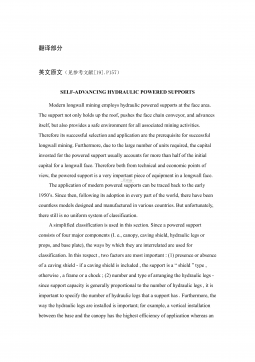
压力之源——泵和压缩机外文文献翻译、中英文翻译


Sources of Pressure -Pumps and Compressors
Fundamentally most pumps suitable for pumping hydraulic fluid will operate
with air or gas, although most oil pumps make poor air compressors, and some
compressors will not operate with incompressible fluid without modification.
General considerations. The main requirements of a hydraulic pump capable of
delivering sufficiently great a pressure to be of practical use, are:
a. Means for controlling fluid leakage either by special seals of close working
clearances.
b. A substantially uniform, non-pulsating delivery.
c. The absence of trapping of fluid during rotation, since the fluid is for all
practical purpose incompressible.
d. Mechanical balance to a sufficient degree to enable the pump to be run as fast
as possible, to reduce bulk for a given output.
e. Adequate provision for minimizing the effect of distortion of the working
parts, casings, ect., due to the internal pressure in the pump.
f. Low clearance volumes so that the pump will act momentarily during priming,
or with aerated fluid, as a compressor, to discharge the air through the delivery line,
instead of leaving It trapped in the pump.
g. Adequate inlet valve or port provision to enable the pump to creat a good
suction, or alternatively, as in the case of aircraft, to operate at high altitude, and with
relatively thick fluids. It should be noted that the time of opening of the inlet valve or
port is almost as important as the size of the port.
The main requirements of a good compressor are:
a. The smallest possible clearance volume compatible with mechanical
clearance; this is because any gas compressed in the clearance volume will expand
again instead of being discharged, and will thus adversely affect not only the output
of the pump, but the maxium pressure that can be achieved.
b. Except on low-pressure pumps, two or more stages of compression with as
much intercooling between stages as possible. This is desirable, firstly, to reduce the
wastage of work and output due to the gas being compressed adiabatically instead of
isothermally, and, secondly, to reduce the overall loss of output due to clearance
volume.
c. Pre-compression of the air in the pump up to the pressure of the delivery line.
Although the normal reciprocating pump with an automatic or spring-load delivery
valve will ensure this, some of the rotary compressors have to be ported specially to
obtain pre-compression, and with some it is nor possible at into the pump, and the
whole volume has again to be compressed. A rotary compressor with pre-compression
cannot be operated with hydraulic fluid.
d. Provision for air or water cooling of the cylinder so that the temperature of the
air in the compression cannot be operated with hydraulic pump.
e. Means for controlling gas leakages during compression either by pistonrings
on a reciprocating piston compressor, or fine clearance on the rotary types.
f. Adequate inlet valve area to prevent throttling of the incoming air, with the
consequent loss of volumetric efficiency.
The main types of pump and compressor use pistons, meshing gears or rotating
vanes, these having been found to give good high pressure performance. Other types
of pumps, such as centrifugal pumps or turbo-compressors, are not used for pressure
systems as they do not produce high enough pressure to be useful.
Variable Speed Hydraulic Systems
It is particularly important on many hydraulic systems, as on machine tools, to
be able to vary the speed of operation at will. This can be carried out in the following
ways, sometimes more than one way being combined:
a. By varying the pump output manually;
b. By using several pumps in combinations;
c. By restricting or throttling the output of a automatically variable delivery
pump, or a pump accumulator system, or by throttling the inlet;
d. By by-passing part of the pump output with a flow dividing valve;
e. By varying the volume of the operating jack.
1.Variation in pump delivery. Pump delivery can be varied by
a. Alteration in its speed;
b. Alteration of its stroke in a variable stroke type of pump;
c. Using two or more pumps of different delivery in parallel so that by stopping
and starting the pumps in various combinations different total deliveries can obtained.
The first system is an easy one when the pump is electrically driven, although
the electric motor involved is comparatively complicated for normal requirements.
Mechanical variable speed gear boxes have been used successfully with constant
speed electric drive.
Several of the pump mechanisms previously described can readily be adapted to
give a varying output by reducing the working strok manually by means of a control
wheel, etc.
The third system is simple enough, but varies the output in fixed steps. Two
pumps in parallel can give three ranges of output corresponding to
Pump A, Pump B, Pump A plus B.
Three pumps in parallel can give seven steps corresponding to
Pump A, Pump A plus B, Pump B plus C,
Pump B, Pump A plus C, Pump A plus B plus C.
Pump C.
Since, however, variable stroke pumps are readily available, such a complication
as three pumps in parallel hardly seems worthwhile although the two-pump system is
probably excellent for such duties as presses, etc. where a great of the working stroke
is at low pressure, where a pump for the final working stroke. Automatic isolation of
the low pump can be effected by a valve. Any normal type of automatic cut-out will
operate in the low-pressure system to by-pass it, without interference from the other
pump.
2. Restriction of Pump Output. With a variable delivery pump the flow of oil to
the system proper can be metered through a restriction, the delivery of the pump
automatically adjusting itself to the reduced flow. An automatic flow control valve or
throttle is to be preferred to a simple restrictor. This is an extremely simple system,
but is liable to variation of speed owing to change in viscosity of the oil, temperature
effects, etc. And the metering restriction may have to be adjusted from time to time to
keep the speed constant. On the other hand, it is possible to evolve a restriction
compensated for changes. By fitting the flow control valve in either jack line, control
in one directions only can be exercised, but note that as the volumes of the jack
returning to tank may not be same in both directions, the degree of speed control may
not be similar.
3.Use of Flow dividing Valves. The flow dividing valves of various types are
used to control the speed of a system by –passing part of the pump output, even if at
the expense of a slight wastage of power. It is possible to use a selector incorporating
several ports, which in turn control of fluid past several different flow dividing
valves, giving different rates of flow for each position of the selector.
4.Variation in hack volume. Another means of obtaining variable speed from a
constant delivery pump is use jacks of different volumes (i.e. at different pressures),
either in parallel, or using a multi-volume construction. If, for example, the machine

摘要:
展开>>
收起<<
SourcesofPressure-PumpsandCompressorsFundamentallymostpumpssuitableforpumpinghydraulicfluidwilloperatewithairorgas,althoughmostoilpumpsmakepooraircompressors,andsomecompressorswillnotoperatewithincompressiblefluidwithoutmodification.Generalconsiderations.Themainrequirementsofahydraulicpumpcapableofd...
相关推荐
-
2024年党建工作要点工作计划5篇供参考
 2023-12-16 999+
 -
2025年专题生活会对照带头严守政治纪律和政治规矩,维护党的团结统一等“四个带头方面”个人对照检查发言材料4110字文稿
 2024-12-21 999+
 -
2025年医保局局长、科技局领导干部专题“四个带头”方面对照检查材料2篇例文(附:反面典型案例剖析情况)
 2025-02-09 514
 -
2025年国有企业党委书记、市总工会党组书记民主生活会“四个带头”方面对照个人检查发言材料2篇文(附:典型案例、上年度整改+个人情况)
 2025-02-09 551
 -
2025年市委组织部部长、教育局党委书记生活会“四个带头”个人对照检查发言材料2篇文(典型案例+个人事项)
 2025-02-09 675
 -
2025年市财政局党组书记、局长、市检察院党组领导班子对照“四个带头”方面生活会个人对照检视发言材料2篇文(含以案为鉴反思、以案促改促治方面)
 2025-02-09 559
 -
市检察院党组、市财政局领导班子2025年生活会对照“四个带头”方面检视发言材料2份文【含以违纪行为为典型案例剖析】
 2025-02-09 484
 -
2025年市财政局领导对照“四个带头”生活会检视发言材料2篇例文【含以违纪行为为典型案例剖析】
 2025-02-09 610
 -
单位领导班子2025年聚焦“四个带头”生活会对照检查材料2篇文(含:典型案例剖析反思、落实意识形态责任制)
 2025-02-09 805
 -
2025年镇党委副书记、市科学技术局领导班子生活会对照“四个带头”检视材料2篇文【含违纪行为典型案例分析】
 2025-02-09 279
作者:设计吧
分类:课程设计课件资料
价格:10光币
属性:10 页
大小:45.5KB
格式:DOC
时间:2023-02-13